
Front Page
News
Previews
Reviews
Features
• 3DO - the forgotten console
• Sex, Lies & Videogames
• Alien Vs Predator

Gamer Life
Feedback
Charts
Release Schedule
Diary
Next Week
Paper View
On the website:

Screenshot Xtra
Hints and Tips
Demos
Patches and Upgrades
Stream Lounge
Chat forum

|
|
 |
| Issue 16 - February 25, 1999
|
|
| |
|
Feature
|
| 3DO - the forgotten console |
|
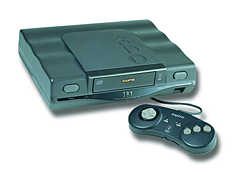
Contrary to popular belief, the PlayStation and Saturn were not the first 'next generation' videogame consoles. They were not the first machines to feature CD-ROM drives as standard, to feature 32bit processors and to boast impressive realtime 3D visuals. There was another. In the dark days between the 16bit age and the arrival of Sony's epoch-making console, there stood a bulky, maverick stranger. A stranger named 3DO...
Keith Stuart
Originally launched in the US on October 4, 1993, the 3DO console (often cruelly nicknamed ‘3DOA’, or simply ‘3DOH!’) will go down in videogame history as one of the industry's more interesting and heroic failures. The machine was essentially the brainchild of Trip Hawkins - founder and ex-head honcho of Electronic Arts and, from 1990 onwards, CEO of the 3DO company.
His bewilderingly ambitious plan was to develop a standard console platform, rather like the VHS video recorder, the blueprints of which would be licensed out to third-party electronics manufacturers. These companies would then build their own versions of the machine, enabling them to access the profitable console market without having to go through the costly and financially dangerous process of developing their own hardware. All other non-3DO-based machines were simply meant to die off in spectacular Betamax fashion.
On paper at least, the 3DO had much in its favour. The architecture was designed by technical gurus David Needle and RJ Mical who previously worked on the Amiga - one of the most successful homecomputers of all time. Centred around a powerful 32bit RISC processor, the internal set-up included two video coprocessors and a revolutionary Direct Memory Access engine which enabled huge slabs of data to be hurled around the machine's insides without jamming up the CPU - a handy little feature for all those maths-intensive 3D visuals.
Thanks to this impressive spec list and the persuasive talents of Trip Hawkins - who could talk the hind AND fore legs off a donkey and then sell the limbless creature two pairs of roller skates - it wasn't long before several electronics firms showed interest. Eventually, Panasonic, Sanyo and AT&T all committed themselves to producing consoles based on the 3DO architecture, and Goldstar would later join the fray.
|
|


