|
Review
|
| Tomb Raider: The Last Revelation |
| PC |
Price: £39.99 |
From: Eidos |
| Players: 1 |
Age: 15 |
Release: Out Now |
| Minimum spec: P166, 3D card, 16Mb RAM, 4x CD-ROM drive. Oh, and a decent joypad, if you've got any sense. |
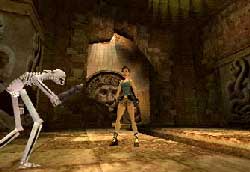
Or Tomb Raider: The Lust Re-Evaluation, as it has come to be know. Does anyone really find Lara Croft attractive? Ugh. She's so plastic, pristine and sculpted, it makes us sick. Remember Sooty's bird, Sue? Now there's a real woman...
James Price
To understand why Tomb Raider: The Last Revelation is so good, you have to grasp just why Tomb Raider was so right, and how TR2 and TR3 got things wrong.
One frequent criticism of the first two Tomb Raider sequels is that their attempts at worldly environs - remember Venice and London? - were vague, abstract, and thoroughly unrealistic. Rocky crags? Fantastic. Perilous ravines? Equally so. But it's a simple fact that the Lego-like nature of Core's engine does not lend itself readily to urban locales; its specialities are claustrophobic caves and vertiginous cliff faces. Similarly, hoofing great levers and movable blocks may be appropriate for a trap-filled Egyptian ruin - in a fantasy sense, of course - but they're woefully out of place on Canary Wharf (remember the disappointing London section of TR3?)
And combat? That was a problem, too. Tomb Raider was a master of many trades. Visually outstanding, its set pieces were arguably ahead of its time. The T-Rex of the Lost Valley level? The Abomination of the last level? The dizzying heights of St Francis's Folly? Magnificent moments, one and all. But - and whisper it - it was a bit pants where combat was concerned.
Lara negotiates platforms with aplomb, but is oddly clumsy in a fight. There's no fun to be had in leaping inanely from side to side, taking unavoidable hits from a generic, gun-toting assailant. It just heightens your awareness of the fact that you're sitting in front of a TV or monitor - and not despoiling the gravegoods of some dead emperor with a potential Wonderbra marketing campaign assailing your peripheral vision.
Perhaps the greatest asset that Tomb Raider had - and, if you revisit it, still has - is that it engenders an amazingly pure sense of isolation. In most games, you're constantly assailed by events. You take that as read, and enjoy them for that very reason. Tomb Raider, however, could dump you in the middle of a massive playfield, chuck in the occasional bit of combat for the sake of variety, but generally just let you get on with things. And it worked.
|